

Gummy candies, jelly sweets, and many marshmallows carry the highest risk of pork gelatin, since manufacturers rely on animal collagen to set that signature chew. The fastest way to avoid it: check the package for “gelatin-free” or “vegan” wording, look for a Halal or Kosher certification logo, and when in doubt, pull up the product’s ingredient page online before you buy.
- Highest-risk categories: gummy bears, jelly candies, and some marshmallows almost always use gelatin unless the label says otherwise.
- Trust signals to scan for: Halal or Kosher certification marks, explicit “porcine” or “bovine” wording, and “made in” country labeling, which often hints at the formulation.
Swedish Fish is a good example of a gelatin-free exception in its classic U.S. formula, according to Chef’s Resource, though formulations can shift by market, so a quick label check still matters even for familiar brands.
Key Takeaways
Gummy candies and marshmallows carry the highest pork gelatin risk, while certification logos and direct label checks remain the most reliable way to avoid it.
| Point | Details |
|---|---|
| Highest-risk categories | Gummy bears, jelly candies, and marshmallows most often use gelatin, sometimes porcine. |
| Certification beats guessing | Halal and Kosher logos disclose animal source even when general labeling law doesn’t require it. |
| Formulations vary by country | The same brand can use different gelatin sources depending on where it’s manufactured. |
| Plant-based alternatives trade texture | Pectin, agar, and starch avoid pork but produce a different chew than gelatin. |
| Sweetsbysvea offers checkable options | Products like Swedish Fish and Polkagris list full ingredients for easy verification before you order. |
Table of Contents
- Which Candy Types Commonly Contain Pork Gelatin?
- Why Do Manufacturers Choose Pork Gelatin Over Alternatives?
- How Can You Verify If a Candy Uses Pork Gelatin?
- What Are the Best Non-Pork Alternatives to Gelatin?
- How Sweetsbysvea Helps You Shop Gelatin-Free
- Does Pork Gelatin Sourcing Cost More Environmentally Than Alternatives?
- What Labeling Laws Govern Pork Gelatin in Candy?
- Our Take: Labels and Certification Beat Guesswork Every Time
- Where to Find Clearly Labeled, Gelatin-Free Swedish Sweets
- Sources
Which Candy Types Commonly Contain Pork Gelatin?
Gelatin shows up almost exclusively in candies that need to set into a chewy, springy structure. Gummy bears, worms, and jelly candies are the biggest offenders, since gelatin is what gives them that stretch-and-snap bite. Marshmallows use it too, along with some frosted or cream-filled confections where a soft, whipped texture depends on gelatin’s ability to trap air.
What makes this tricky is that the same candy name doesn’t guarantee the same recipe everywhere. A gummy bear made in Germany might use a different gelatin source than the identical-looking product made under license in another country. Manufacturers formulate around local supply chains, religious dietary markets, and cost, which means the ingredient list is the only reliable guide, not the brand name or packaging design.
Here’s roughly how candy categories break down by gelatin likelihood:
- Gummy bears and worms: high likelihood of gelatin, often porcine depending on the market.
- Jelly candies and fruit slices: frequently gelatin-based, though some use pectin instead.
- Marshmallows: commonly gelatin-based, especially mass-market brands.
- Fish-shaped and starch-set gummies: often gelatin-free, since starch or pectin can replicate the chew.
- Hard candies and lollipops: almost never contain gelatin, since they don’t need a gelling agent at all.
Swedish Fish falls into that last, gelatin-free bucket in its typical formula. Other candies marketed as “chewy” without being classic gummies, like taffy or caramel, usually rely on sugar cooking rather than gelatin, so they’re generally a safer bet if you’re avoiding animal-derived gelling agents altogether.
Why Do Manufacturers Choose Pork Gelatin Over Alternatives?
Pork gelatin isn’t the default because manufacturers aren’t thinking about it. It’s the default because it performs. Porcine gelatin produces a clearer gel with fewer cloudy batches, and it melts at a temperature close to body heat, which is exactly why a gummy bear feels firm in the bag but dissolves smoothly in your mouth. Industry explainers note that gelatin is frequently listed generically as E441 precisely because manufacturers value its functional clarity and melt behavior over specifying the source animal.
There’s also a supply and cost angle. Pork is one of the most widely farmed proteins globally, and the gelatin extracted from pig skin and bones is a byproduct of an already massive meat industry, which keeps it cheap and consistently available compared to some alternatives.
- Clearer, glossier gels than many plant-based substitutes achieve.
- Melting point close to body temperature, giving that “melts in your mouth” quality.
- Lower cost and steady supply due to global pork production volume.
- Predictable chew and snap that candy makers can fine-tune batch to batch.
Pro Tip: If a gummy candy feels unusually firm or takes longer to dissolve on your tongue, it may be using a starch or pectin base instead of gelatin. It’s a rough clue, not a substitute for reading the label.
How Can You Verify If a Candy Uses Pork Gelatin?
Reading a candy wrapper is a skill, and most shoppers never learn to do it properly. Here’s the order that actually works:
- Scan the ingredient list first. Look for “gelatin,” then check if it specifies “porcine,” “bovine,” “fish,” or simply says “gelatin-free.”
- Check for certification logos. Halal and Kosher marks are strong indicators of non-porcine sourcing, but confirm the certifying body’s name rather than trusting an unfamiliar symbol.
- Note the country of manufacture. A candy made in a Muslim-majority country is statistically more likely to use beef or fish gelatin, while European and American products vary widely by brand.
- Cross-check the product line. The same brand can use different recipes in different countries, so a product page or regional label matters more than brand reputation alone.
- Contact the manufacturer directly if the label is ambiguous. Ask specifically: “Is the gelatin in this product porcine, bovine, or fish-derived?”
For certification questions specifically, resources like Navigate Food’s labeling compliance guidance walk through how legitimate certifiers operate, which helps you tell a real logo from a decorative one.
When labels fail, laboratories can settle the question outright.
Researchers have shown that FTIR spectroscopy combined with PCA and PCR can reliably distinguish pork gelatin from bovine gelatin in jelly candy samples, confirming source identity down to the molecular level.
That’s a lab-grade trust signal, not something you can replicate at home, but it’s reassuring to know the technology exists behind the certifications you’re trusting.
What Are the Best Non-Pork Alternatives to Gelatin?
Plant-based and mineral-derived gelling agents have come a long way, and several now show up regularly in candy that’s marketed as vegan or gelatin-free. Pectin, extracted from fruit peels, produces a softer, slightly more fragile gel than gelatin, closer to what you’d find in a fruit preserve than a bouncy gummy bear. Agar, derived from seaweed, sets firmer and doesn’t melt at room temperature the way gelatin does, which changes the mouthfeel noticeably. Potato and corn starch create a denser, chewier texture rather than a springy one, and carrageenan, another seaweed extract, is often blended with other agents for structure in jellies.
- Pectin: soft, slightly brittle set, common in fruit-forward jellies.
- Agar: firm, heat-stable gel that doesn’t dissolve in the mouth the same way.
- Potato or corn starch: dense, chewy texture, popular in Scandinavian recipes.
- Carrageenan: often used alongside other agents for added structure.
Swedish candy makers lean heavily on starch-based gelling, and that regional trend is exactly why so many Swedish sweets are naturally gelatin-free without needing a special “vegan” reformulation. The texture is different, chewier and denser rather than bouncy, but for anyone avoiding pork gelatin, it’s a meaningful tradeoff. The simplest shortcut still stands: look for “gelatin-free” or “vegan” on the package before assuming.
How Sweetsbysvea Helps You Shop Gelatin-Free
Sweetsbysvea ships authentic Swedish candy and grocery items worldwide, with freshness and delivery in 1 to 3 days, and every product is free from GMOs, parabens, and high fructose corn syrup. That matters here because Scandinavian confectionery, as a category, tends toward starch and pectin-based gelling rather than gelatin, which gives you a wider pool of naturally compliant options to start from.
Three products worth checking directly on their product pages:
- Polkagris: a classic Swedish hard candy, a category that generally skips gelling agents altogether.
- Swedish Fish: a starch-set gummy known for its gelatin-free formula.
- Toms Pingvin Häxvrål: a Swedish favorite worth checking for its current ingredient listing.
Pro Tip: Always open the full ingredient list on the product page before ordering, even for items you’ve bought before. Formulations can shift, and the label is your fastest confirmation.
Does Pork Gelatin Sourcing Cost More Environmentally Than Alternatives?
Pork gelatin production is tied directly to the environmental footprint of pig farming, which includes land use, feed crops, water consumption, and methane and waste output from livestock operations. Because gelatin is a byproduct of meat and hide processing, its environmental cost is partly absorbed into the broader pork industry rather than existing as a standalone footprint, which makes direct comparisons tricky.
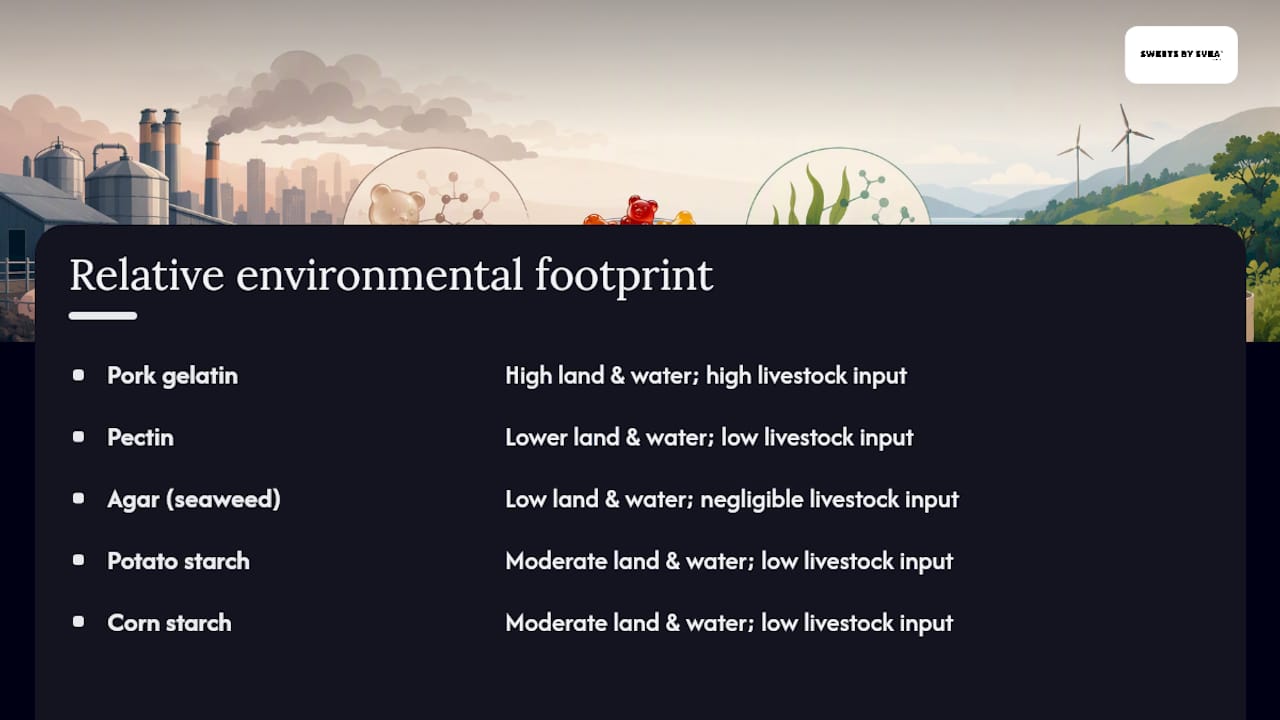
Plant-based alternatives carry their own tradeoffs. Pectin, often derived from citrus peels or apple pomace, uses agricultural byproducts that would otherwise go to waste, which generally gives it a lighter footprint than raising livestock specifically for gelatin extraction. Agar comes from farmed or wild-harvested seaweed, a crop that doesn’t require freshwater irrigation or arable land the way livestock feed does, making it one of the lower-impact gelling agents in terms of land and water use. Potato and corn starch sit somewhere in between, since they depend on crop farming with its own fertilizer and water demands, though generally at a smaller scale than raising animals.
None of these comparisons are simple, because gelatin’s status as a byproduct muddies the math. A pig raised primarily for meat that also yields gelatin doesn’t carry the same environmental “cost” as an animal raised solely for that purpose. Still, for shoppers weighing options, starch and seaweed-derived gelling agents generally involve fewer direct livestock inputs, which is part of why Scandinavian candy makers favor them so heavily.
What Labeling Laws Govern Pork Gelatin in Candy?
Labeling requirements for gelatin vary considerably depending on where a candy is manufactured and sold, and that inconsistency is exactly why reading the package carefully matters more than assuming a universal standard exists. In many regions, gelatin can legally be listed under a generic term or an E-number code without specifying whether it’s derived from pork, beef, or fish, which is a major reason shoppers get caught off guard.
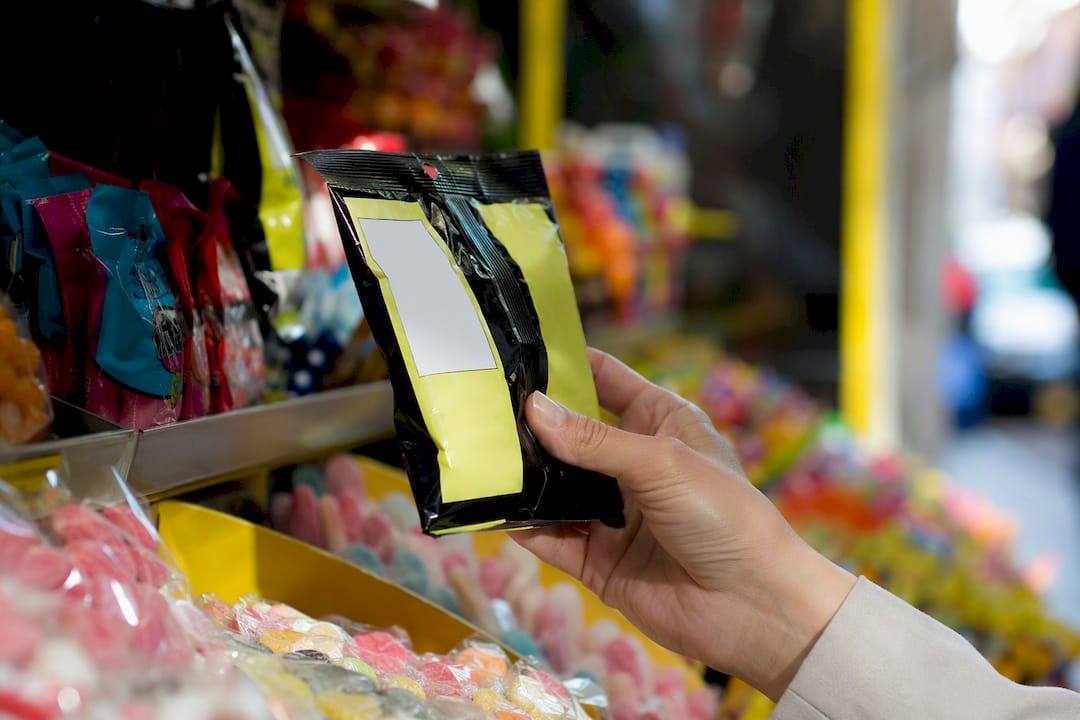
Countries with significant Muslim or Jewish populations often have stricter labeling frameworks tied to Halal and Kosher certification, requiring explicit disclosure of animal source when a product carries those certification marks. Outside of those specific certification schemes, though, general food labeling law in most countries doesn’t mandate that manufacturers specify the animal source of gelatin on the ingredient panel.
This regulatory gap is precisely why third-party certification carries so much weight. A Halal or Kosher logo isn’t just a religious marker. It functions as a de facto disclosure system that fills in what general labeling law leaves out. Shoppers relying purely on the ingredient panel, without checking for certification, are often working with incomplete information by design, not by accident. Where legal requirements are unclear, checking a certifier’s own verification standards remains the most dependable path.
Our Take: Labels and Certification Beat Guesswork Every Time
The conventional advice to “just read the ingredients” undersells how little the ingredient panel actually tells you. “Gelatin” alone, without a country of origin, a certification mark, or direct confirmation from the manufacturer, is functionally meaningless if you’re trying to avoid pork specifically. That’s the gap most consumer advice glosses over.
What the evidence actually supports is a layered approach: certification logos first, country and product-line clues second, and manufacturer contact as the tiebreaker. Lab methods like FTIR and PCR prove pork gelatin can be identified with scientific precision, but that’s a manufacturer and regulator tool, not something you’ll do in your kitchen. Treat it as reassurance that certification systems have real teeth behind them, not as a substitute for checking labels yourself.
If there’s one habit worth building, it’s this: stop trusting brand reputation and start trusting the specific product page in front of you. Formulations shift by country and by year. The label you read last time isn’t a guarantee for the one you’re holding now.
— Sweets
Where to Find Clearly Labeled, Gelatin-Free Swedish Sweets
Sweetsbysvea is built around exactly this problem: candy shoppers who want to know what’s actually in the bag before they order it. Every product page lists full ingredients, so you can check for gelatin source, certification notes, and country of manufacture without digging through a manufacturer’s customer service line first.
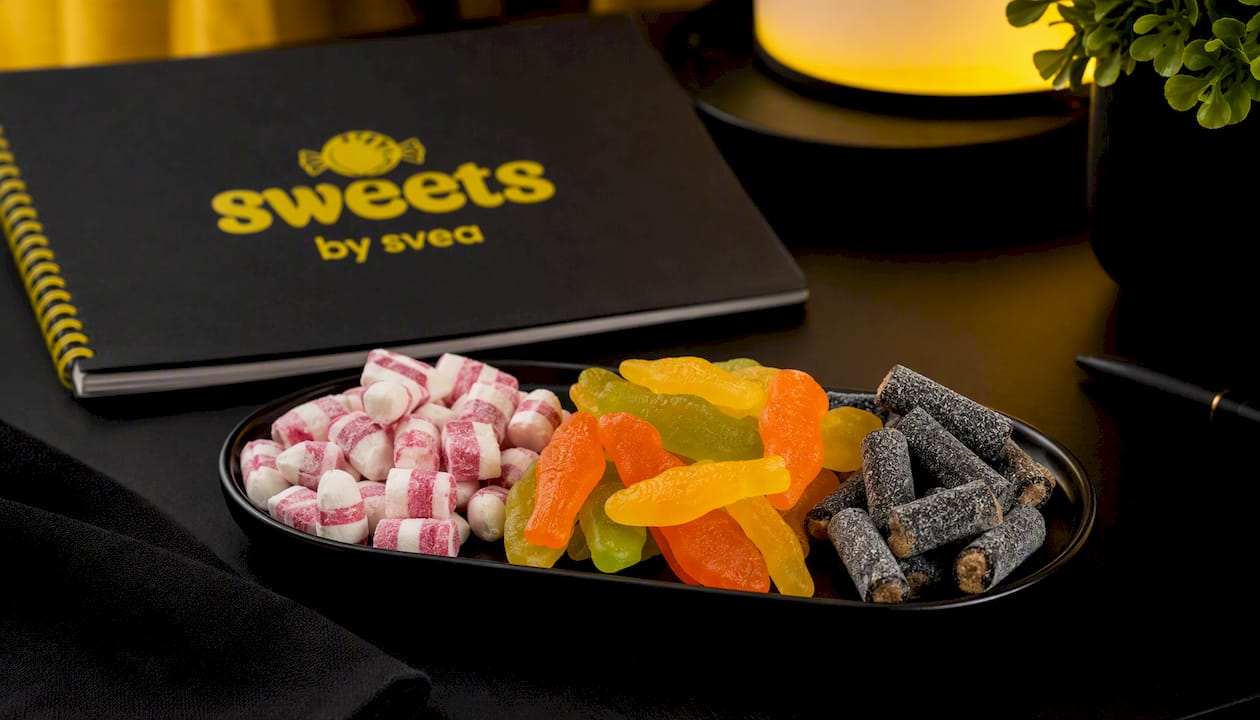
Start with the Swedish candy guide to understand which categories lean starch-based, then browse specific products like Polkagris or vegan gummy options like Wellibites Jordgubb Cola, which is sugar-free and plant-based from the ground up. Orders ship worldwide with freshness guaranteed and delivery in 1 to 3 days, so you’re not waiting weeks to find out if the candy matches what the label promised. If a product page leaves any doubt about ingredient sourcing, reach out to customer service directly and ask before you buy, not after the package arrives.
Sources
- Detection of Pork Gelatin in Jelly Candy Using FTIR and PCR (ICSTUNKHAIR 2021 proceedings)
- Decoding your candy: how to know if gelatin is pork or beef labels – MallorysKitchen