

Yes, many commercially packaged, shelf-stable food gifts can enter the U.S., but every one of them must be declared. Customs and Border Protection, the FDA, and USDA/APHIS jointly decide what clears and what doesn’t, and even a company like Sweetsbysvea has to work inside those same rules. Declare the contents, itemize everything, and skip restricted categories like fresh produce or most meats. Business shipments face a different set of rules entirely, starting with FDA prior notice.
TL;DR:
- Commercially packaged candies, chocolates, and canned goods are the safest options for crossing the border without issues, while fresh produce and most meats are almost always banned.
- Proper declaration with detailed, itemized descriptions reduces inspection delays and prevents seizure by providing customs with the necessary information upfront.
- Sending consolidated gift boxes requires individual wrapping, labeling, and detailed packing lists to avoid being treated as a commercial shipment, which incurs duties.
- Using the correct shipping method, such as express for perishables and cold packs for chocolates, along with appropriate insurance, minimizes transit delays and damage.
- Accurate, specific declarations and labeling are more effective at avoiding problems than worrying about regulatory overreach, since honest gift-givers are rarely targeted.
Table of Contents
- Which Foods Clear Customs and Which Get Stopped
- What You Need to Declare and Which Forms Apply
- How Gift Value Rules Affect Duties
- Packing and Labeling That Actually Reduces Delays
- Choosing a Shipping Method That Won’t Slow You Down
- What Happens If Customs Inspects or Seizes Your Gift
- What Sweetsbysvea’s Shipping Experience Actually Looks Like
- Why Most Guides on This Topic Undersell the Paperwork
- Sending Swedish Sweets? Here’s What Ships Cleanly
- Sources
Which Foods Clear Customs and Which Get Stopped
Packaging matters more than most people expect. A sealed bag of hard candy from a Swedish grocery store sails through inspection far more easily than a loose bag of homemade cookies, because officials can verify commercial origin, ingredients, and manufacturing standards at a glance.
Shelf-stable, factory-sealed goods are the safest bet for anyone trying to send or carry food gifts across the border. That includes:
- Commercially packaged candy, chocolate, and licorice
- Most dry snacks (crackers, chips, dried fruit that’s been processed, not raw)
- Canned goods, with one major exception: cans containing meat often face restrictions depending on origin
- Some cured cheeses, which are frequently admissible but depend on the specific product
The prohibited and restricted side of the list is longer and less forgiving. Fresh fruit and vegetables are almost always barred because they can carry pests or plant diseases that don’t exist in the U.S. yet. Many meats and meat products fall under similar restrictions tied to animal disease risk, and some dairy products face limits for the same reason. Plants, seeds, and soil are treated with particular suspicion. Honey sits in a gray zone, too. Its status can shift depending on country of origin and how it’s processed.
None of this is arbitrary. CBP’s own guidance on agricultural products makes clear that the concern is pest introduction and animal disease, not the food itself. When a restricted item genuinely needs to cross the border, USDA/APHIS runs a permit process for specific exceptions, though that route is built for commercial importers more than for someone mailing grandma a care package. Bakery items, candy, chocolate, and many cured cheeses typically clear without issue, according to guidance from the U.S. Embassy in Italy on sending food to the United States, while canned or vacuum-packed goods need a second look at their ingredient list before you ship them.
What You Need to Declare and Which Forms Apply
Every traveler and every shipper faces a declaration moment, just through different paperwork.
If you’re flying into the U.S. with food in your bag, the CBP Declaration Form 6059B asks whether you’re carrying agricultural items. Answer yes if there’s any doubt, then present the items at inspection. Travelers who check “no” and get caught with food in their luggage face real consequences: seizure and civil penalties are both on the table under CBP’s agricultural product rules.
Shippers face a parallel but separate process:
- Complete the customs form required by your carrier, typically a CN22 for lower value items or a CN23 for higher value ones.
- List each item individually with description, quantity, value, and country of origin. “Assorted candy” is weaker than “200g packaged licorice, Sweden.”
- Mark the package “Unsolicited gift” when it qualifies, since that phrase carries specific weight under CBP’s gift policy.
- Keep a copy of what you filed. It’s the first document you’ll need if anything gets questioned later.
The line between personal and commercial shipments matters more than most senders realize. According to FDA guidance on prior notice, businesses shipping food into the U.S. must file advance prior notice, with specific timeframes depending on the shipping mode. A personal gift from one individual to another generally skips that requirement, though it still goes through standard inspection.
Pro Tip: If you’re mailing food gifts regularly (say, every holiday season to the same relative), save your old customs forms as templates. Consistent, specific language across shipments builds a track record that speeds up future inspections.
How Gift Value Rules Affect Duties
CBP allows unsolicited gifts sent to friends or relatives in the U.S. duty- and tax-free up to a certain value, with a higher allowance for gifts sent from insular possessions like the U.S. Virgin Islands. The CBP gift exemption rule comes with a catch that trips up a lot of senders: If any single item inside the gift package exceeds the allowed value, the entire package becomes subject to duty.
Consolidated gift boxes, meaning one shipment carrying presents for multiple recipients, follow a stricter set of expectations:
- Each item must be individually wrapped and labeled inside the box
- A packing list should identify which item goes to which recipient, along with its value
- The outer package should be marked to indicate it contains multiple separate gifts
Skip the individual labeling and CBP may treat the whole box as one commercial shipment, wiping out the gift exemption entirely. That single oversight is often the difference between a package that clears in a day and one that sits in a bonded warehouse while a broker sorts out the paperwork.
Packing and Labeling That Actually Reduces Delays
What you write on the customs form determines how long inspection takes. Vague language reads as evasive even when it isn’t; specific language reads as routine.
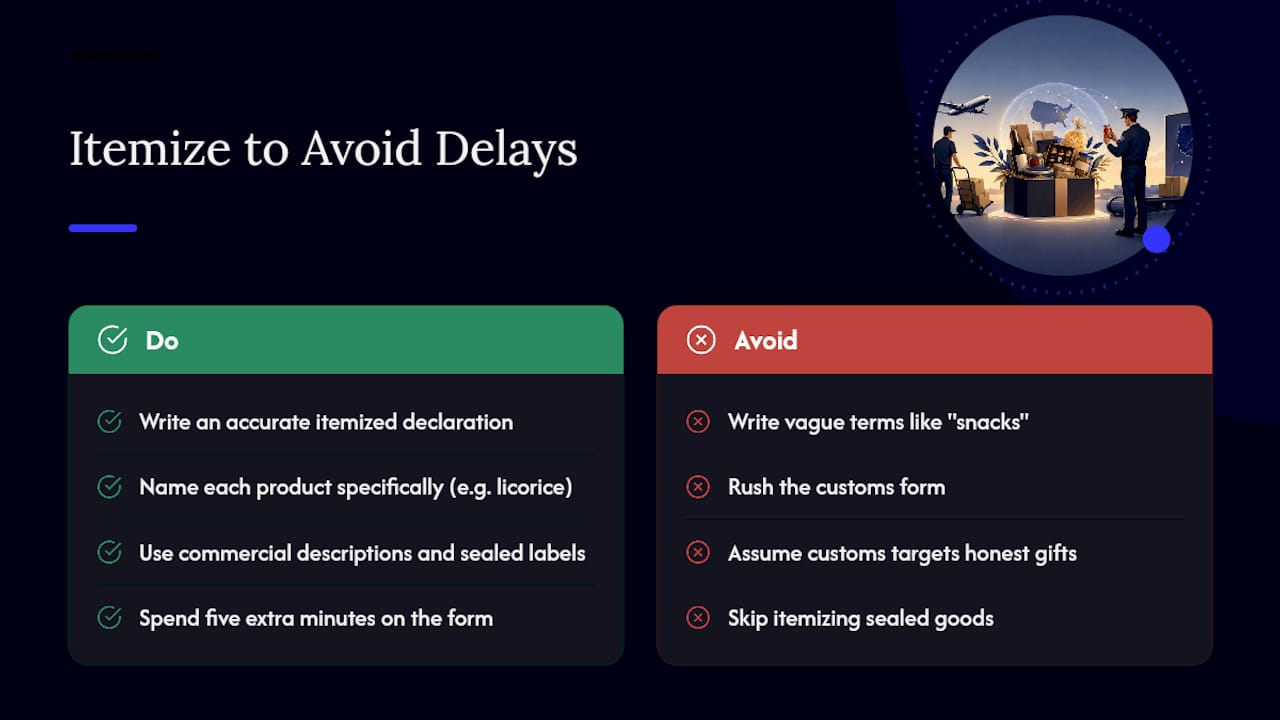
Compare these two approaches: “assorted snacks” versus “2 x 90g commercially packaged Danish licorice candy, country of origin: Denmark, ingredients: sugar, glucose syrup, licorice extract.” The second version gives an inspector everything needed to make a fast decision. CBP has said as much directly: precise, itemized descriptions consistently reduce handling time compared to generic labels like “food” or “snacks.”
Follow this sequence when you pack:
- Keep factory seals and original packaging intact. A resealed bag looks like tampering even when nothing was tampered with.
- Write the ingredient list and country of origin directly on the customs form, not just on the product itself.
- Skip decorative wrapping paper on anything that might get opened for inspection. Officials in similar programs, including Canada’s CBSA guidance for travelers, recommend the same thing: let the box be inspected without tearing through gift wrap first.
- For chocolate or anything else sensitive to heat, use cold packs and choose expedited transit. Our own guide to cold-pack chocolate shipping covers the temperature math in more detail.
- In a consolidated package, tag each item with the recipient’s name and value, and write the combined total clearly on the outside.
Pro Tip: Take a photo of your packed box, contents visible, before you seal it. If a dispute ever comes up, that photo backs up your declaration far better than memory does.
Choosing a Shipping Method That Won’t Slow You Down
Postal services and private couriers handle customs entry differently, and that difference shows up in your wallet and your timeline.
National postal services generally route packages through customs with lower brokerage fees but slower, less predictable timelines. Private couriers add tracking and speed, but often charge separate brokerage fees on top of shipping. That fee can catch a gift-giver off guard if they weren’t expecting to pay anything beyond postage.
- Business shipments may trigger carrier-filed FDA prior notice, so confirm with your carrier whether that applies before you ship
- Perishable or temperature-sensitive items do best on express services, since a few extra days in transit can ruin chocolate or anything that needs refrigeration
- Add insurance on higher-value packages. If a shipment gets seized or destroyed, refund policy depends entirely on the carrier, not on customs
- Check your carrier’s return policy before shipping, since some carriers return rejected packages automatically while others require the sender to request it
What Happens If Customs Inspects or Seizes Your Gift
A flagged package has four realistic outcomes: it clears after a quick look, it goes to a lab for testing, it gets seized and destroyed, or it gets returned to sender. Refunds depend entirely on your carrier’s policy, not on any customs agency.
- Contact your carrier’s customs broker first if a package stalls; they can usually tell you the specific reason
- For agricultural concerns, USDA/APHIS is the relevant contact; for labeling or ingredient disputes, that’s FDA territory
- Have your invoice, ingredient labels, and any permits ready to send immediately
- Keep records of every shipment, since a pattern of clean, accurate declarations helps if problems recur
Under CBP’s agricultural rules, declarations are treated as legal documents. Getting one wrong isn’t a paperwork slip. It’s the kind of mistake that triggers fines.
What Sweetsbysvea’s Shipping Experience Actually Looks Like
Shipping Swedish candy internationally for years teaches you which products travel well and which don’t. Shelf-stable licorice and packaged sweets clear customs with far less friction than anything perishable, and routing chocolate on cold-pack methods within a 1 to 3 day delivery window keeps it intact regardless of season.
A working checklist looks like this:
- Write an itemized label: product name, weight, ingredients, country of origin
- Match the carrier to the product: express and cold pack for chocolate, standard service for shelf-stable candy
- Note temperature sensitivity directly on the shipping label if it applies
- Include ingredient documentation with every international order, not just the ones likely to be inspected
Why Most Guides on This Topic Undersell the Paperwork
Most advice about sending food gifts abroad treats customs as an obstacle to dodge rather than a process to work with. That framing gets people in trouble. The senders who run into seizures and delays are almost never the ones sending something exotic. They’re the ones who wrote “snacks” on a form instead of naming the product.
The conventional wisdom oversells the danger of shipping food internationally and undersells the value of specificity. CBP and FDA rules aren’t designed to catch honest gift-givers; they’re designed to catch pest risk and mislabeled commercial goods. A well-labeled box of commercially sealed licorice has far more in common, from a customs standpoint, with a box of canned soup than with a suitcase of fresh produce.
If there’s one thing worth prioritizing above all else, it’s this: spend five extra minutes writing an accurate, itemized declaration. That single habit does more to prevent delays than any amount of worrying about which agency might flag your package. The rules are public, consistent, and genuinely followable. Most problems come from rushing the form, not from the food itself.
— Sweets
Sending Swedish Sweets? Here’s What Ships Cleanly
If you’ve read this far, you already know that shelf-stable, well-labeled candy is exactly the category that clears customs with the least friction. That’s the entire category Sweetsbysvea works in.
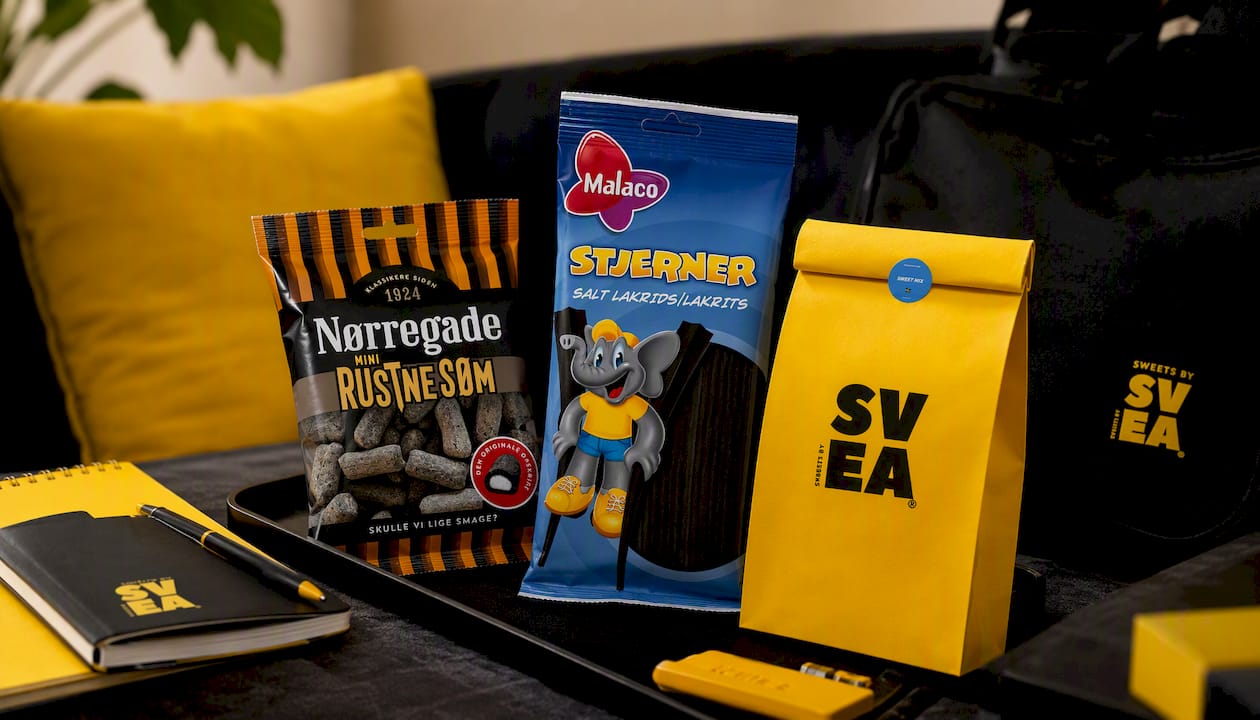
We ship commercially packaged Swedish licorice and sweets with the ingredient and origin details already sorted, delivery arriving quickly, and packing practices built around what customs officers actually want to see on a label. Our Licorice Lovers assortment is a straightforward example: sealed, shelf-stable, and itemized the way CBP prefers. If you want something more specific, the Nørregade Rystne Søm licorice candy and the Malaco Saltlakrits Stjerner salty licorice are both single-item picks that travel well and label cleanly on a customs form.
One honest limit: we don’t ship meats, most dairy, or anything that requires a special USDA/APHIS permit. If you’re ready to send something that actually clears, start with the Licorice Lovers page and build your order from there.
Sources
- Bringing agricultural products into the United States | U.S. Customs and Border Protection
- What you need to know about prior notice of imported food shipments | FDA
- Bringing/Sending Food and Alcohol to the U.S. — U.S. Embassy & Consulates in Italy