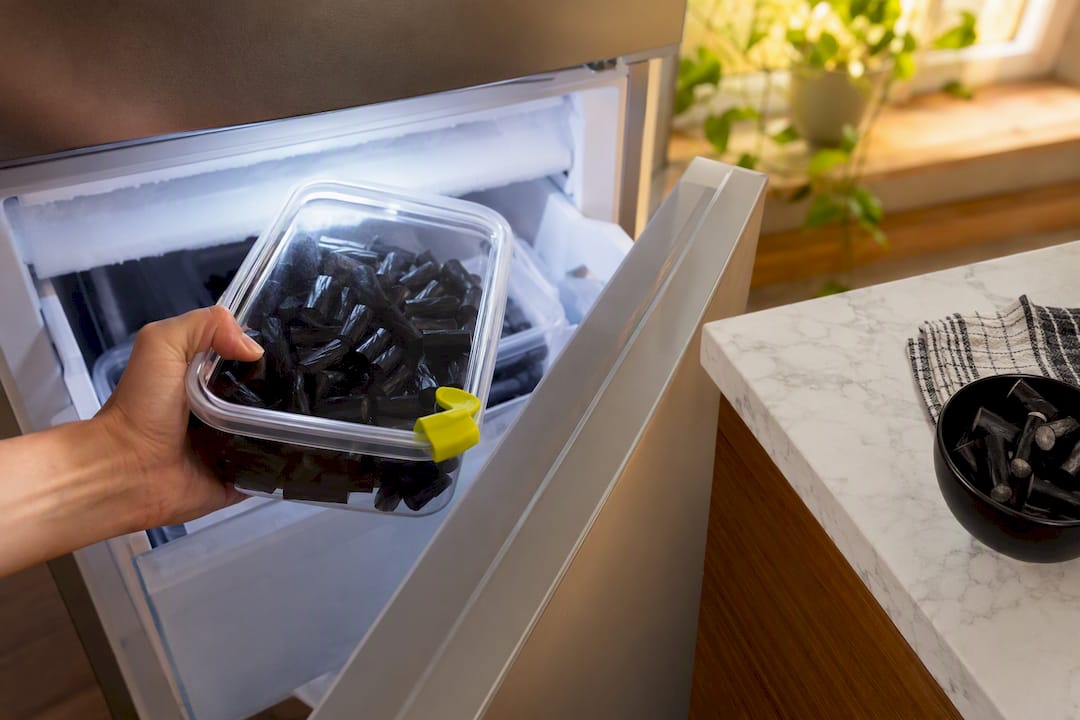

Yes, you can ship candy internationally in most cases, but three things decide whether it arrives instead of getting stuck at a border. First, confirm the destination country actually allows the ingredients you’re sending. Second, describe every item precisely on customs paperwork instead of just writing “candy.” Third, if chocolate is involved, pick a fast or temperature-controlled shipping method, since standard ground transit can turn a nice gift into a melted mess.
TL;DR:
- Shipping chocolate internationally is risky unless you use temperature-controlled shipping and rely on carriers with rapid transit options.
- Accurately describing each candy item with specific names, HS codes, and origin details on customs forms prevents unnecessary delays or seizures.
- Countries like Australia and New Zealand strictly restrict nuts, seeds, gelatin, and certain alcohol-flavored fillings, which can lead to confiscation.
- Sending low-value gift parcels in a post-Brexit EU context may now incur VAT or duties unless handled with delivered duty paid options.
- For safe delivery of non-perishable or shelf-stable candies, trusted couriers with temperature handling and proper packaging significantly improve the chances of intact arrival.
Table of Contents
- Pre-Pack Checklist: Will Your Candy Clear Customs?
- What Do You Write on Customs Forms for Candy?
- Should You Use a Postal Service or a Courier?
- How Do You Pack Chocolate So It Doesn’t Melt?
- Which Ingredients Get Candy Rejected at the Border?
- How Do You Ship Candy Internationally, Step by Step?
- How Sweetsbysvea Handles International Candy Shipping
- When Should You Skip DIY Candy Shipping Entirely?
- Skip the Guesswork: Ship Candy That’s Built to Travel
- Sources
- FAQ
Pre-Pack Checklist: Will Your Candy Clear Customs?
Before you print a shipping label, run through this list. Skipping even one item is how packages end up seized, delayed, or returned at the sender’s expense.
- Destination rules first. Look up the receiving country’s food import restrictions, not just general customs rules. Countries treat sugar candy, chocolate, and gummies differently.
- Scan for banned ingredients. Nuts, seeds, gelatin, and alcohol-flavored fillings trigger holds in several markets.
- Decide if it’s heat-sensitive. Chocolate and anything with a cream or caramel center needs different handling than hard candy or gummies.
- Write it all down. Have your ingredient list, Harmonized System code, net weight, and unit value ready before you pack.
- Confirm carrier acceptance. Some couriers exclude perishable food from standard insurance, so check the fine print before assuming you’re covered.
Get these five right and you’ve eliminated most of the reasons candy shipments get stopped.
What Do You Write on Customs Forms for Candy?
Vague descriptions are the number one reason food parcels get flagged. Writing “candy” or “sweets” on a customs form tells an inspector nothing, and that ambiguity is exactly what triggers a manual check. Instead, describe each item the way a customs officer would want to see it.
- Name the product specifically. Write “milk chocolate caramel candies” or “sugar free caramel candy, 42g” rather than “assorted candy.”
- Include the Harmonized System code. Sugar confectionery generally falls under the appropriate HS code for sweets, while chocolate and chocolate-containing products require their own specialized HS code. Getting this wrong can misroute your shipment through the wrong inspection queue, according to World Trade Organization guidance on harmonized coding.
- Match the form to the carrier. Postal shipments typically require a CN22 (for lower-value parcels) or CN23 (for higher-value or heavier ones), while courier services like DHL or FedEx generally want a commercial invoice even for personal shipments.
- Add country of origin and unit value per item, not just a lump sum for the whole box.
Pro Tip: If you’re shipping to the United States, food imports may require FDA prior notice before the shipment arrives. Missing this step is one of the most common reasons food parcels sit in a warehouse instead of moving to delivery.
One more thing worth knowing: the EU’s removal of its duty-free threshold means low-value gift parcels can now attract VAT or duties that didn’t apply before. Paying duties upfront through a Delivered Duty Paid (DDP) option avoids a surprise bill landing on your recipient’s doorstep.
Should You Use a Postal Service or a Courier?
Postal services (USPS, Royal Mail, and similar national carriers) are cheaper but slower, and slower is the enemy of chocolate. Express couriers like DHL or FedEx cost more but move faster and often offer temperature-aware handling options for food shipments.
- Postal services work fine for hard candy, gummies, and shelf-stable sugar confectionery that isn’t racing a clock.
- Express couriers make more sense for chocolate or anything with a filling, since transit time is the biggest variable in whether it survives the trip.
- Clearance fees add up. Couriers often charge separate customs clearance or food-handling fees that can rival the cost of shipping itself, so factor that into your total before you commit to a carrier.
- Insurance limits vary. Ask directly whether a carrier’s standard insurance covers perishable food, since many exclude it by default.
Pro Tip: Anything shipped in transit longer than 48 hours in warm weather is a real gamble for chocolate, even with gel packs. If your route runs longer than that, consider DDP with a broker who handles food-specific clearance, rather than hoping standard service gets it through fast enough.
How Do You Pack Chocolate So It Doesn’t Melt?
Packaging is where most DIY candy shipments fail, and it’s also the easiest problem to fix with the right materials. DHL’s shipping guidance points to three factors that matter most: insulation, coolant, and speed.
- Use a box within a box. An inner insulated liner (foam or insulated foil) inside your shipping box creates a buffer against temperature swings during handling.
- Skip dry ice. It’s classified as dangerous goods under IATA regulations and is restricted or banned on most international air routes. Gel packs or tested phase-change material (PCM) are the compliant alternative.
- Count your gel packs. As a rough guide, A small box on a one to two day shipping route often requires multiple gel packs to maintain adequate cooling; longer transit times call for PCM designed to hold a stable temperature longer.
- Block movement inside the box. Loose items shift, crush, and generate friction heat. Fill gaps so nothing can move once the box is sealed.
- Watch for condensation. Moisture from melting gel packs can ruin packaging and labels if it touches the product directly, so wrap coolant separately from the candy itself.
Chocolate that survives a domestic move can still fail internationally simply because the trip takes three extra days at a customs hub, which is exactly why cold-pack methods matter more for cross-border routes than local ones.
Which Ingredients Get Candy Rejected at the Border?
Certain ingredients trigger biosecurity holds regardless of how well you’ve packed the box. Countries with strict agricultural protections, Australia and New Zealand being the clearest examples, routinely flag anything containing nuts, seeds, or undeclared dairy for inspection or destruction.
- Nuts and seeds raise biosecurity concerns in Australia, New Zealand, and several Gulf states.
- Gelatin can be restricted in countries with religious dietary import rules, particularly across parts of the Middle East.
- Alcohol-flavored fillings face restrictions in several Gulf countries regardless of the actual alcohol content.
- Novelty items with embedded toys are refused in some markets even when the candy itself is fine, since the toy component falls under separate safety regulations.
- The EU applies its own food additive rules, so a coloring or preservative that’s standard in one country can be non-compliant there.
Confiscation is the best-case outcome for a noncompliant shipment; the worst case is a fine or a flagged customs record for future shipments. Check the destination country’s food import database before you ship, not after.
How Do You Ship Candy Internationally, Step by Step?
- Check destination rules and pick your items. Rule out anything with banned ingredients before you even start packing.
- Choose your carrier and service level. Decide whether DDP is worth the extra cost for a smoother delivery experience.
- Complete the paperwork. Use specific product descriptions, correct HS codes, and accurate net weights and values.
- Pack with insulation and coolant if needed. Label the box clearly and consider adding shipping protection for peace of mind.
- Track the shipment and respond fast. If customs requests more information, reply immediately with your documentation on hand. Delayed responses are what turn a routine hold into a returned or destroyed package.
How Sweetsbysvea Handles International Candy Shipping
Sweetsbysvea ships Swedish candy, snacks, and grocery items worldwide. Their products aim to offer familiar flavors to those who miss them. Orders typically ship quickly, and products are made without GMOs, parabens, or high fructose corn syrup.
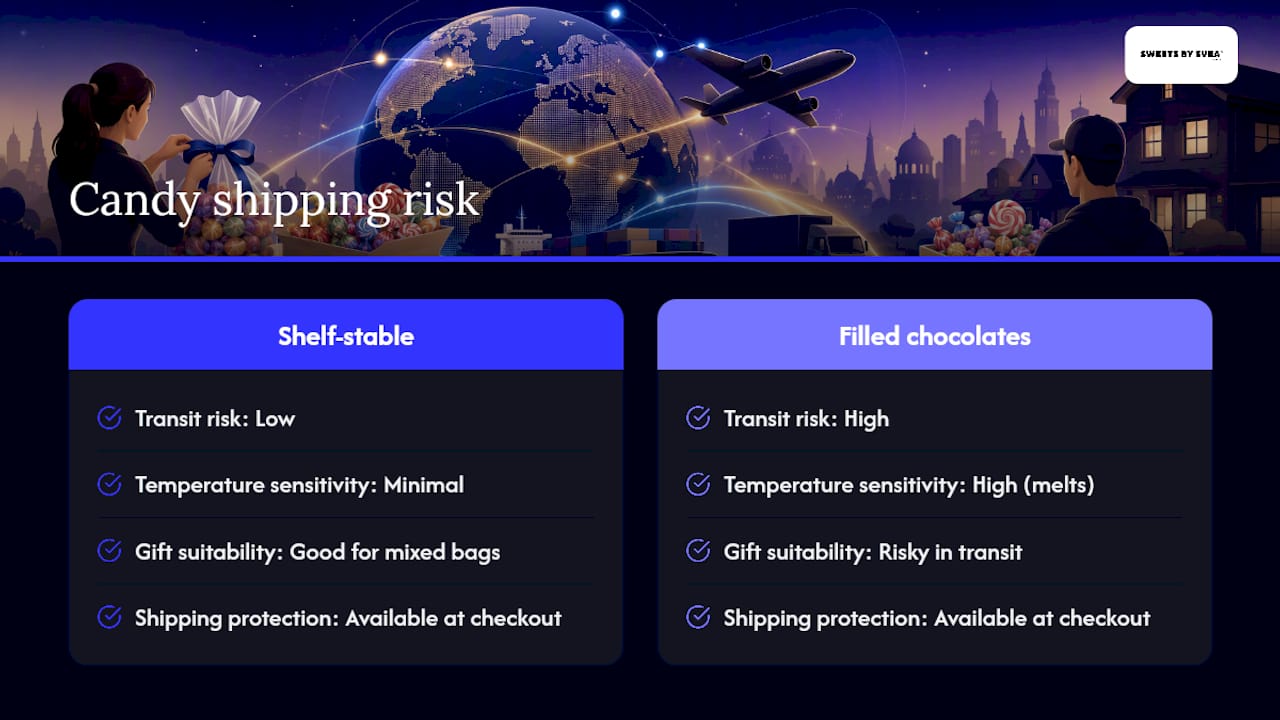
Shipping protection is available at checkout to cover the kind of transit risk this article just walked through. For gift-giving specifically, mixed candy bags and shelf-stable sweets travel with far less risk than filled chocolates, since they aren’t racing a temperature clock the way a truffle is.
When Should You Skip DIY Candy Shipping Entirely?
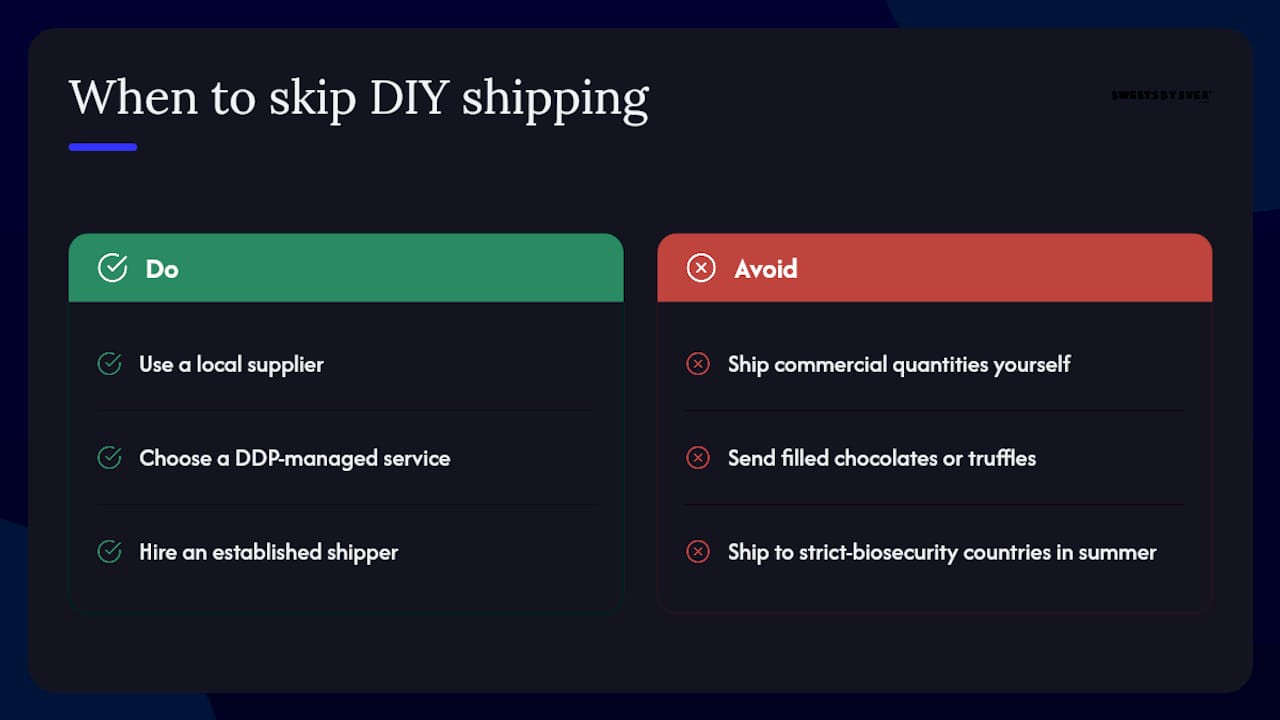
DIY shipping stops making sense once volume, product type, or destination risk climbs too high. Commercial-quantity shipments, filled chocolates or truffles, and anything headed to a strict biosecurity country during summer months are all situations where the paperwork and packaging burden outweighs the savings.
In those cases, a local supplier, a DDP-managed service, or an established shipper like Missy Lala’s ASB Food Show Special is the safer route. The math is simple: the cost of doing it right rarely beats the cost of a shipment destroyed at the border.
— Sweets
Skip the Guesswork: Ship Candy That’s Built to Travel
Packing your own candy shipment means juggling HS codes, gel pack counts, and a customs form that has to be exactly right, every single time. Sweetsbysvea removes that risk by handling the logistics end to end, with orders shipped worldwide within 1 to 3 days and Shipping Protection available at checkout for extra coverage on every order.

For gifts that don’t need a cold chain to survive the trip, the Werther’s Cream Candies Mini Sockerfri Ask travels well in any climate, and the Malaco Kalaspatrullen candy bag gives you a mixed assortment without the melting risk chocolate carries. If you’re not sure how a specific destination will treat your order, reach out to customer service before you check out. They can flag ingredient or country concerns before you pay for shipping, not after.
Sources
- How to ship chocolates internationally - DHL
- World Trade Organization (WTO) - technical barriers to trade resources
FAQ
What Items Cannot Be Shipped Internationally?
Beyond candy-specific bans like unlisted nuts or gelatin, most countries prohibit dry ice as a coolant, undeclared alcohol content, and any food item missing an accurate ingredient list on the customs form.
Does Candy Need to Be Declared at Customs?
Yes, every candy shipment needs a customs declaration listing specific product descriptions, HS codes, net weight, and value, regardless of whether it’s marked as a gift.
What Is the Best American Candy to Send Overseas?
Shelf-stable options without chocolate or nut content travel most reliably, since they skip both the temperature-control problem and the most common biosecurity flags.
Can I Mail Candy to Someone?
You can mail candy to someone internationally as long as it complies with the destination country’s food import rules and carries accurate customs paperwork. Marking the package as a “gift” does not exempt it from those requirements.