
Plan on about 4 to 5 ounces of candy per guest for a standard candy buffet, and increase the amount for kid-heavy parties or longer events. That works out to roughly a quarter to a third of a pound per person. Below, we break down the chart, the formula, and container sizing so you can shop once and get it right.
TL;DR:
- At 4 ounces per guest, 50 people need 12.5 pounds; raise the allowance to 6 ounces for busy events, bringing that total to 18.75 pounds.
- Separate favor bags add 2 to 3 ounces per guest; buffet bags avoid that extra allowance, but require reserve candy near the event’s end.
- For 50 guests, prepare 6 to 8 jars with a dedicated scoop or tongs for each, plus one favor bag per person and 10% extra.
- Label each jar for allergens and dietary status, then group suitable options together so guests can find choices without checking every container.
- Order at least a week before the event, especially for international delivery, because customs or carrier delays can disrupt even fast shipping.
Table of Contents
- Candy Amounts at a Glance: Chart and Quick Rules
- The Formula: Scaling Candy for Any Guest Count
- Picking Jars and Scoops That Match Your Totals
- What to Buy Beyond the Candy Itself
- Storing and Reusing Leftover Candy the Right Way
- Ordering Swedish Candy for Your Buffet or Favors
- Candy Buffet vs. Favor Bags: How to Split Your Total
- Candy Variety and Dietary Considerations
- Matching Candy Choices to the Season and the Event
- Balancing Textures for a Table That Feels Complete
- How Age Groups Change Your Candy Math
- Budgeting for Candy by the Person
- What Years of Candy Orders Teach You About Planning
- Order Your Candy Buffet Essentials Today
- FAQ
- Sources
Candy Amounts at a Glance: Chart and Quick Rules
Before you touch a calculator, a simple chart answers most of what you need. A common rule of thumb for candy buffets lands at about 3 to 5 ounces per guest, with planners adding extra for longer celebrations or events heavy on children. We find 4 to 5 ounces per person hits the sweet spot for most parties, scaling up from there.
For group totals, the math holds steady: at 4 ounces per person, 20 guests need roughly 5 pounds, 50 guests need about 12.5 pounds, and 100 guests about 25 pounds.
A balanced buffet mix also matters more than raw weight. Industry guidance suggests a percent-split works well across most events:
- Bulk fillers (about 40% of total weight): inexpensive wrapped candies that fill jar volume fast.
- Visual anchors (about 20%): tall items like lollipops or rock candy sticks that draw the eye.
- Chewy and wrapped pieces (about 30%): fruit chews, gummies, and individually wrapped classics.
- Salty reset (about 10%): pretzels or salty snacks that break up the sweetness.
Kid-heavy events tend to run lighter on sophisticated chocolates and heavier on gummies and chewy candy, while adult-only parties can shift more weight toward anchors and specialty imports.
The Formula: Scaling Candy for Any Guest Count
The core formula is simple: multiply your guest count by ounces per guest, then divide by 16 to get pounds. In metric terms, multiply guests by grams per guest, then divide by 1,000 for kilograms.
Here is how that plays out at a 4 ounce baseline and at a 6 ounce upper range for busier events:
- 20 guests: 20 × 4 oz = 80 oz, or 5 pounds at the baseline; at 6 oz, that climbs to 7.5 pounds.
- 50 guests: 50 × 4 oz = 200 oz, or 12.5 pounds at the baseline; at 6 oz, that becomes 18.75 pounds.
- 100 guests: 100 × 4 oz = 400 oz, or 25 pounds at the baseline; at 6 oz, that reaches 37.5 pounds.
Once you have a target weight, round up to the nearest common bag size rather than ordering an odd amount. A 2 pound bag, a 5 pound bag, or a bulk case are easier to track than a precise but awkward figure like 12.5 pounds split across three different bag sizes. Rounding up by half a pound or a full pound also builds in a small buffer for spills, double-scooping, and guests who come back for seconds.
Picking Jars and Scoops That Match Your Totals
Container size determines how full your table looks, not just how much candy you buy. A standard 64 ounce jar filled three-quarters full holds enough for roughly 15 to 20 guests at the baseline rate, while a larger 1 gallon jar at the same fill level covers closer to 25 to 30 guests.
- Small jars (32 to 48 oz): best for rare or expensive items used as accents, filled halfway to two-thirds.
- Medium jars (64 oz): the workhorse size for bulk fillers and chewy candy, filled three-quarters full.
- Large jars (1 gallon or more): reserved for visual anchors or the most popular item, since a full gallon reads as abundant even when lightly used.
- Scoop sizing: a 1 ounce scoop suits individually wrapped pieces, while a 2 ounce scoop moves loose candy faster for high-traffic tables.
Place your tallest and fullest jars at the back of the table so smaller jars in front do not get visually lost, and stagger scoop placement to keep guests from clustering at one spot.
What to Buy Beyond the Candy Itself
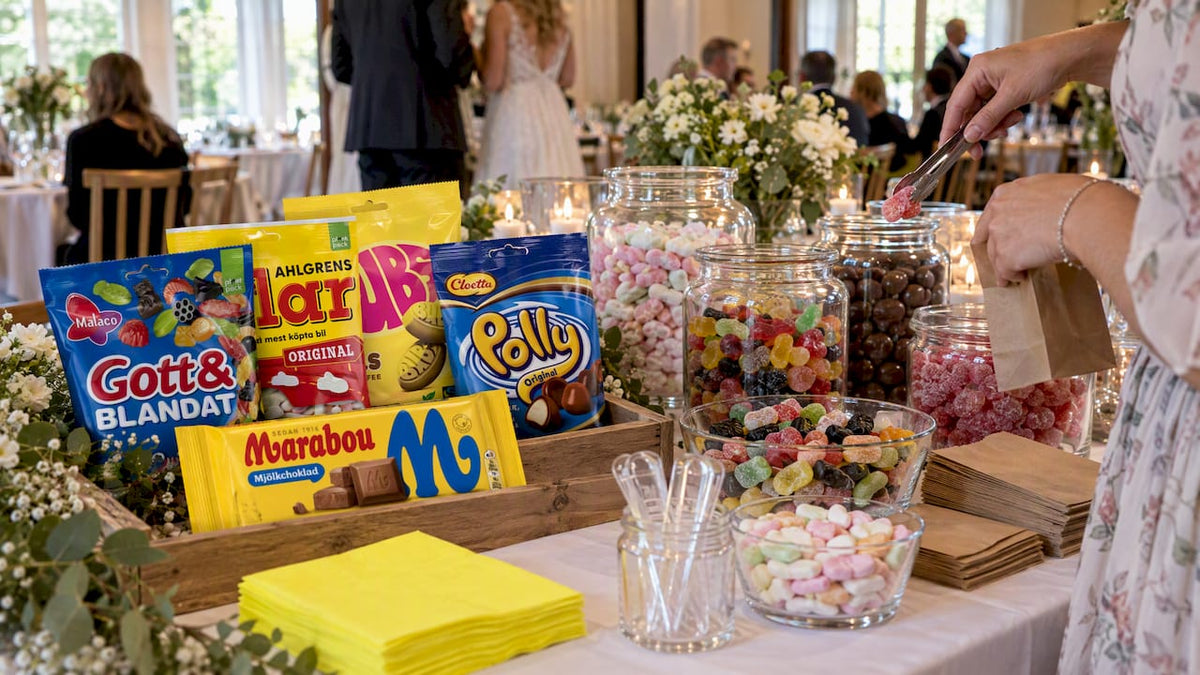
A candy buffet needs more than candy. For a 50-guest setup, plan on 6 to 8 jars, one scoop or set of tongs per jar, and 50 favor bags so every guest can take some home. Add labels for each jar (especially for allergen or dietary notes), a small sign explaining self-serve etiquette, and a stack of extra bags near the end of the table to keep the line moving.
- Jars and scoops: 6 to 8 jars with a dedicated scoop or tongs for each, never shared between jars.
- Favor bags and ties: one bag per guest, plus 10% extra for breakage or second helpings.
- Signage: at least one ingredient or allergen label per jar, plus a general table sign.
- Hygiene supplies: hand sanitizer near the table and a plan to swap scoops if one falls into a jar.
Candy cost ranges widely depending on the mix of bulk fillers versus specialty imports, so budget loosely per pound rather than per piece.
Pro Tip: Reusable glass jars cost more upfront but survive multiple events, which lowers your real cost per party over time.
Storing and Reusing Leftover Candy the Right Way
Store leftover candy in a cool, dry spot in airtight containers to keep texture and flavor intact; chocolate-based pieces generally hold up for a few months this way, while gummies and hard candy last longer. Our storage guide covers specifics by candy type.
Rather than letting extras sit forgotten, repackage them into small gift bags, use them as thank-you favors for helpers, or donate unopened packages. Label leftover containers with the date and candy type so you know what is freshest the next time you plan an event.
Ordering Swedish Candy for Your Buffet or Favors
Once you know your total weight and mix ratio, shopping becomes a matter of matching catalog picks to your percent-split. We ship authentic Swedish candy worldwide within 1 to 3 days, which makes last-minute top-ups realistic even for events booked on short notice.
- Ahlgrens Bilar Limousines: a chewy, wrapped classic that fits neatly into the chewy and wrapped portion of your mix.
- Swedish Fish: a bulk filler that scoops easily and fills jar volume fast at low cost per ounce.
- Candy Lovers Favorite: a mixed assortment that works well as a visual anchor jar since it offers variety in one container.
For planners mixing multiple selections, our guide to building a custom candy box walks through combining flavors and textures from the full catalog.
Candy Buffet vs. Favor Bags: How to Split Your Total
A candy buffet and a favor bag serve different jobs, and conflating them leads to overbuying. The buffet is a display meant to be grazed throughout the event, while favor bags are a fixed take-home portion handed out at the end.
For the buffet itself, plan your full 4 to 5 ounce baseline per guest, since that number already accounts for display loss, double-scooping, and visual fullness. Favor bags are a separate line item: budget an additional 2 to 3 ounces per guest if you want a distinct take-home bag rather than letting guests self-serve into a bag from the buffet table.

Some planners skip the separate favor bag and simply let guests fill a bag from the buffet near the end of the event. This saves on total candy volume since you are not duplicating the per-person allowance, but it also means your buffet needs enough reserve stock toward the end to avoid empty jars. If favors are the priority (for example, at a wedding where guests take a bag home as a keepsake), weight your order toward pre-packed bags and treat the buffet as secondary with lighter jars.
Events with both a buffet and dedicated favors should budget separately for each and avoid pulling candy originally meant for jars into bag-filling duty, since that throws off your careful percent-split.
Candy Variety and Dietary Considerations
A buffet that ignores dietary needs excludes guests, so build variety in from the start rather than treating allergen options as an afterthought. Common concerns include nut allergies, gluten content in some chewy and chocolate-coated candies, and gelatin-based gummies that are not vegetarian or vegan.
Label every jar clearly, listing major allergens and whether an item is vegan or gluten-free. Group allergen-friendly options together in one area of the table so guests with restrictions can shop confidently without reading every label on every jar.
Imported Swedish candy often differs from American products in ingredient sourcing. Our comparison of European and American candy explains labeling and ingredient differences relevant to planners buying internationally, including which products tend to avoid high fructose corn syrup and synthetic dyes common in some domestic brands.
Vegan and gluten-free guests are often a small fraction of a guest list, but a dedicated jar or two costs little relative to the goodwill it generates. Treat these options as a standard line item in your shopping list, not a special request.
Matching Candy Choices to the Season and the Event
Candy selection should echo the occasion, not just fill jar space. Summer events favor lighter, fruit-flavored chews and gummies that hold up better in warmer rooms, since chocolate softens and melts faster above typical room temperature. Winter holiday parties can lean into chocolate-heavy selections without the same melting risk.

Birthday parties, especially for children, benefit from bright colors and familiar shapes, while formal events like weddings often favor a more curated, adult palate with imported or specialty items as anchors.
Seasonal packaging also matters for presentation. Many Swedish candies work well year-round as a change of pace from typical American party candy, giving a buffet a distinct identity rather than looking like a standard grocery store assortment. Matching your candy choices to the event theme, whether that means pastel colors for a spring shower or richer flavors for a fall gathering, makes the table feel planned rather than thrown together.
Balancing Textures for a Table That Feels Complete
A buffet with only chewy candy or only hard candy feels monotonous even if the flavors are good. Aim for contrast: pair something crunchy against something soft, and something tart against something sweet.
A practical layout alternates textures jar by jar rather than grouping all similar items together. Place a chewy fruit candy next to a crunchy item, then follow with something smooth like chocolate, so guests moving down the table encounter variety rather than repetition.
Texture contrast also affects how much guests take per visit. Guests tend to sample lightly across a varied table and take larger portions from a single-texture table, since variety naturally slows down grazing. This works in your favor for cost control, since a more varied table can stretch your total candy weight further than a table stacked with one type.
How Age Groups Change Your Candy Math
Children generally eat less per visit to a candy table but return to it more often throughout an event, while adults tend to take a single, larger portion and move on. This means total consumption per person can land similarly across age groups, even though the pattern of eating looks different.
Mixed-age events, like family reunions or birthday parties with both kids and adult guests, benefit from planning closer to the upper end of your per-guest range, since children’s repeat visits add up over a multi-hour event. Adult-only events, such as a cocktail hour or office party, can often plan closer to the baseline since there is less repeat grazing.
If your guest list skews heavily toward children under 10, consider shifting your percent-split toward more bulk fillers and fewer expensive anchor items, since younger guests are less likely to notice or care about specialty imports and more likely to gravitate toward bright, familiar shapes.
Budgeting for Candy by the Person
Once you know your total weight, budgeting becomes a matter of matching your percent-split to price per pound across candy types. Bulk fillers tend to cost less per pound than specialty chocolates or imported items, so a mix weighted more heavily toward bulk candy keeps total cost down even at higher per-guest ounce targets.
A simple budgeting approach: estimate price per pound for each category in your percent-split (bulk filler, visual anchor, chewy and wrapped, salty reset), multiply by the pounds needed in that category, and add the four totals together. This gives a more accurate budget than averaging one flat price across your whole order, since anchor items and imports typically cost more per pound than bulk fillers.
Building in a 10% buffer above your calculated total covers price fluctuations and last-minute additions without forcing a second order close to the event date.
What Years of Candy Orders Teach You About Planning
The most common mistake we see is ordering candy the week of an event and hoping shipping works out, especially for international orders. Build in a buffer of at least a week before your event date, since even fast delivery windows can run into customs or carrier delays. For international orders, checking shipping timelines ahead of time saves a scramble later.
— Sweets
Order Your Candy Buffet Essentials Today
Once your numbers are set, ordering is the easy part. We carry authentic Swedish candy with no GMOs, parabens, or high fructose corn syrup, shipped worldwide within 1 to 3 days so your order arrives with plenty of time to spare.

For a 50-guest buffet, a mix of three jars covers your bulk filler, anchor, and chewy categories without overcomplicating the order. For 100 guests, double the quantities and add a second anchor jar for visual variety.
- Bulk filler: Swedish Fish for fast scooping and low cost per ounce.
- Chewy and wrapped: Ahlgrens Bilar Limousines for a chewy classic guests recognize.
- Visual anchor: Candy Lovers Favorite for an assortment jar that draws attention.
- Browse the full range: explore candy, snacks, and more if you want to build a custom mix beyond these three picks.
If you are shipping candy as gifts or favors across borders, our guide to shipping candy internationally walks through avoiding customs holds. For a dessert table pairing well with a Swedish candy buffet, London’s Sweets offers custom cake pops as a complementary option for late-night dessert tables.
FAQ
How much candy do I need for 20 people?
At the standard 4 to 5 ounce per guest rate, 20 guests need roughly 5 pounds of candy total. It’s wise to round up to a convenient bag size to allow for seconds and spills.
How much candy per person for a candy buffet?
A common rule of thumb lands at 3 to 5 ounces per guest, with most planners settling around 4 to 5 ounces for a standard event. Increase toward 6 to 7 ounces for longer parties or events with many children.
What country eats the most candy per person?
Per-capita confectionery consumption varies by country; recent figures show the United States at 9.8 kilograms per person in 2024, compared with 6.8 kilograms in the UK and 6.0 kilograms in Germany. These are national averages, not event-planning benchmarks.
How many pounds of candy do I need for 100 guests?
At the 4 ounce baseline, 100 guests need about 25 pounds of candy; at a 6 ounce upper range for busier events, that climbs to roughly 37.5 pounds. Round up to the nearest convenient bulk bag size to simplify ordering.
Does Sweets by Svea deliver candy internationally for events?
We ship authentic Swedish candy worldwide with delivery typically arriving within a few days, which supports last-minute event planning. Browse the full catalog of candy and snacks to build an order matched to your guest count.
Sources
- Candy Bar Ideas for Weddings and Birthdays - HARIBO
- World’s Candy and Nonchocolate Confectionery Market Set for Steady Growth with a 1.6% CAGR Through 2035 - News and Statistics - IndexBox