
Short answer: authentic Swedish candy almost never contains Red Dye 40. Most Swedish confectioners color their gummies and licorice with beetroot, black carrot, or fruit concentrate instead of synthetic reds. This holds even though EU rules technically allow Allura Red AC, the chemical name for Red Dye 40 and its E-number, E129.
Two things drive that choice. The EU requires a warning label on food containing certain synthetic dyes, flagging possible effects on children’s activity and attention. No Swedish brand wants that sticker on a candy bag. Second, Nordic shoppers have pushed the industry toward “clean” ingredient lists for over a decade, so plant-based colorants became the default rather than the exception.
- Check for: “E129” or “Allura Red AC” on the label. If you see it, it’s Red 40.
- Common replacements: beetroot juice concentrate, black carrot concentrate, spirulina.
- Trusted example: BUBS licorice sweets typically list black carrot and E153, not E129.
Pro Tip: Scan the ingredient panel for the word “concentrate” (rödbetsjuicekoncentrat, frukt och växtkoncentrat) before you look for E-numbers. If you spot a plant concentrate, the candy almost certainly skipped synthetic dyes altogether.
Key Takeaways
Authentic Swedish candy relies on plant-based colorants almost exclusively, making Red Dye 40 a rare find despite its legal status under EU rules.
| Point | Details |
|---|---|
| Red 40 is legal but rare | EU rules permit E129, but the required warning label pushes Swedish brands toward natural colorants instead. |
| Check for E129 or Allura Red AC | Search any ingredient list for these exact terms to confirm synthetic dye content. |
| Natural terms signal dye-free | Look for “rödbetsjuicekoncentrat” or “frukt- och växtkoncentrat” as signs of plant-based coloring. |
| Swedish Fish name can mislead | Versions manufactured for the U.S. market may use different colorants than Swedish originals. |
| Sweetsbysvea verifies labels | Product pages list full ingredients, and the team will send a label scan on request for any item. |
Table of Contents
- What Red Dye 40 Is and How It Shows Up on Labels
- Why Swedish and U.S. Candy Formulations Diverge
- Real Examples: How Swedish Candy Gets Its Color
- How to Check a Label Before You Buy
- What the Health Evidence and Regulators Actually Say
- What Our Label Checks Found on Authentic Swedish Candy
- Where to Find Verified Red 40 Free Swedish Candy
- Sources
What Red Dye 40 Is and How It Shows Up on Labels
Red Dye 40, Allura Red AC, and E129 are three names for the exact same synthetic colorant. Manufacturers pick whichever name suits their labeling format, so knowing all three matters if you’re scanning ingredient lists.
On American packaging, you’ll usually see “Red 40” or “FD&C Red No. 40” spelled out directly. On Swedish and EU packaging, the same substance appears as E129, sometimes trailed by the parenthetical “(Allura Red AC)” for clarity.
A candy labeled with “rödbetsjuicekoncentrat” or “frukt- och växtkoncentrat” is using a plant-derived colorant, not a synthetic dye. Those Swedish phrases translate to beetroot juice concentrate and fruit and plant concentrate, and they’re the clearest sign a product avoided E129 entirely.
Quick reference for what to look for:
- Synthetic dye indicators: “E129,” “Allura Red AC,” “Red 40,” “FD&C Red No. 40”
- Natural colorant indicators: “beetroot,” “svartmorotskoncentrat” (black carrot concentrate), “spirulina,” “anthocyanins”
- Ambiguous wording to double check: “coloring” or “färg” with no specific source named
Why Swedish and U.S. Candy Formulations Diverge
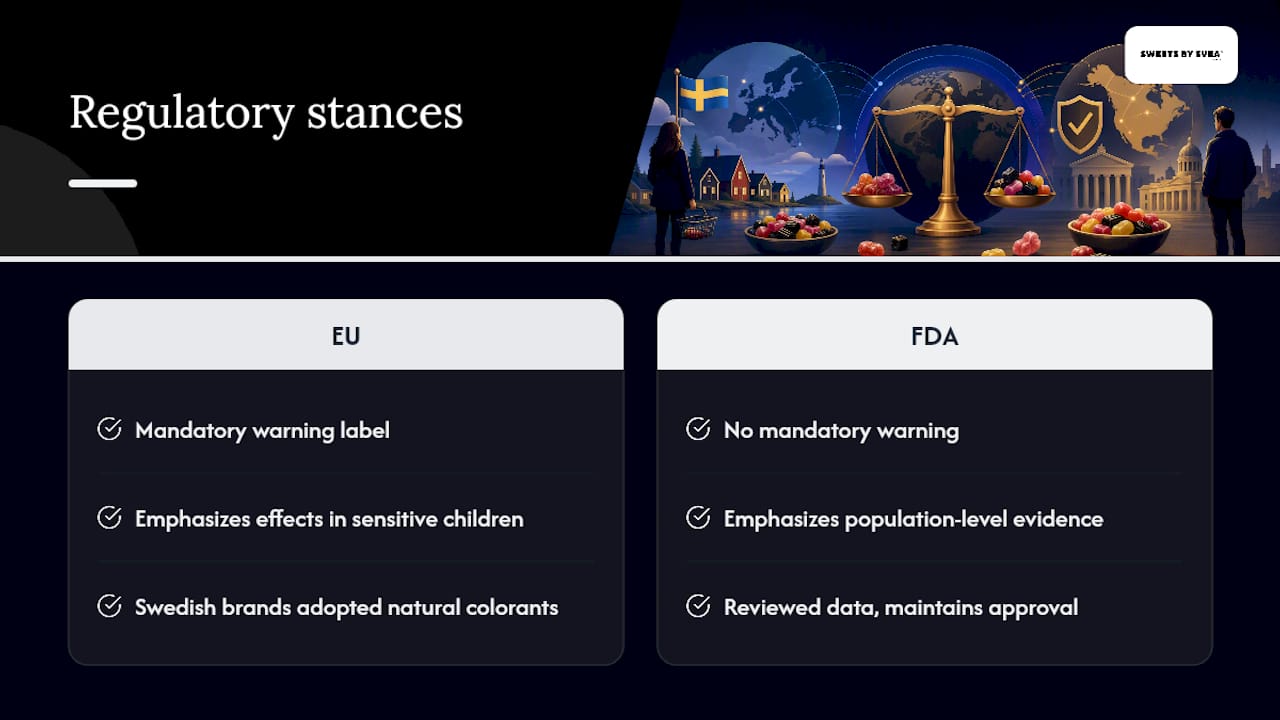
The gap between American and Swedish candy shelves comes down to regulation and consumer pressure working in opposite directions. In the U.S., the FDA has approved Red 40 without requiring any child-attention warning on the package, so manufacturers have little incentive to reformulate. It’s cheap, stable, and produces a consistent, vivid red that natural pigments struggle to match exactly.
The EU took a different regulatory path. Foods containing Red 40 and several related dyes must carry a warning about possible effects on children’s activity and attention. That single label requirement changed the math for Swedish manufacturers.
- No brand wants a “may affect attention” sticker competing for shelf space against a dye-free rival.
- Swedish consumers actively favor short, recognizable ingredient lists, so companies reformulated toward beetroot and black carrot years ago.
- The comparison between Swedish and American dye practices shows this isn’t a legal ban. It’s a market response to a labeling rule.
Worth flagging: Red 40 is still legally permitted in EU candy. It’s just commercially unpopular. That’s a meaningful distinction if you’re relying on “the EU banned it” as your safety logic. It didn’t. Swedish brands simply chose not to use it.
Real Examples: How Swedish Candy Gets Its Color
Look at an actual Swedish licorice label and the pattern becomes obvious fast. BUBS Raspberry Salty Licorice lists black carrot concentrate and E153 as its coloring agents, alongside glucose-fructose syrup and licorice extract. No Allura Red anywhere on that ingredient line.
Sweetsbysvea’s Bubs Skalle Hallon/Lakrits skulls follow the same formulation, and it’s a useful template for what “authentically Swedish” ingredient lists tend to look like: short, plant-derived, and free of synthetic red dye.
Swedish Fish deserves its own callout because it causes the most confusion. The candy most Americans know as “Swedish Fish” is actually a U.S.-market product, originally developed for the North American palate, and its Swedish identity is more marketing than manufacturing origin. U.S.-formulated versions can contain Red 40 or other synthetic dyes depending on the specific product line, so if dye-free ingredients matter to you, check the version’s actual country of manufacture rather than trusting the name on the bag.
Beyond licorice and gummy fish, Sweetsbysvea’s catalog spans well past candy: Ahlgrens Bilar Limousines and the classic Ahlgrens Bilar marshmallow cars both rely on the same natural-colorant tradition, Candy Necklaces give kids a fun format without synthetic reds, and even savory items like the Falukorv Classic, Tunnbrödsrulle Bag, and Göl Parmesan Salami Snacks reflect the broader Swedish preference for simple ingredient sourcing. A recipe collection like 10 Classic Swedish Recipes rounds out the picture for anyone curious about Swedish food culture beyond the candy aisle.
How to Check a Label Before You Buy
Verifying a product takes under a minute once you know the sequence.
- Search the ingredient list for “E129” or “Allura Red AC.” If either appears, the product contains Red 40, regardless of the brand’s country of origin.
- Look for Swedish natural-colorant language, such as “rödbetsjuicekoncentrat” (beetroot juice concentrate) or “frukt- och växtkoncentrat” (fruit and plant concentrate).
- Check the product page for an ingredient scan or full listing before ordering online, since packaging photos don’t always show the full panel clearly.
- Contact the seller directly if the listing is incomplete. A legitimate retailer should be able to confirm or send a label photo on request.
Pro Tip: Use Ctrl+F (or Cmd+F on a Mac) on any product page and search “E129,” “Allura,” or “Red 40” directly. It takes three seconds and eliminates guesswork entirely, especially useful when you’re comparing several products at once.
If you’re shopping for a child with a dye sensitivity, add one more filter: favor products with the shortest ingredient lists you can find, since fewer additives generally means fewer variables to track.
What the Health Evidence and Regulators Actually Say
Regulatory bodies don’t agree on how seriously to treat synthetic dyes, and that disagreement is exactly why Swedish brands hedged toward natural colorants. The EU’s mandatory warning label reflects caution about possible links between certain synthetic dyes and hyperactivity in some children. The FDA has reviewed similar data and maintains approval without requiring the same warning, arguing the evidence doesn’t justify it at a population level.
The gap isn’t really about safety data. It’s about how much weight each regulator gives to effects observed in a subset of sensitive children versus the general population. That’s a judgment call, not a settled scientific fact.
Frameworks like the dietary reference intake guidelines help explain the concept of acceptable daily intake, the threshold below which regulators consider an additive safe for most people most of the time. Sensitive individuals, particularly some children with attention-related conditions, may react at lower thresholds than the general population.
One honest caveat: avoiding Red 40 doesn’t make candy a health food. It’s still sugar, still a treat, and swapping colorants changes exactly one variable in the ingredient list, not the calorie count.
What Our Label Checks Found on Authentic Swedish Candy
Sweetsbysvea reviewed ingredient listings across a sample of its bestselling licorice, gummy, and marshmallow candy lines. The pattern held consistently.
- BUBS licorice skulls: black carrot concentrate, E153, no Allura Red (Red 40).
- Ahlgrens Bilar marshmallow cars: standard Swedish formulation, no synthetic red dyes listed.
- Fish-shaped gummies sold under Swedish branding: ingredients vary by manufacturing market, so the specific product page matters more than the shape or name.
Products manufactured for the U.S. market, even under a Swedish-sounding name, sometimes use different colorants than the version sold and manufactured in Sweden. Always check the specific product’s own label rather than assuming based on brand history.
If a listing doesn’t show a full ingredient panel, that’s worth flagging to the seller before you buy.
A note from Sweetsbysvea
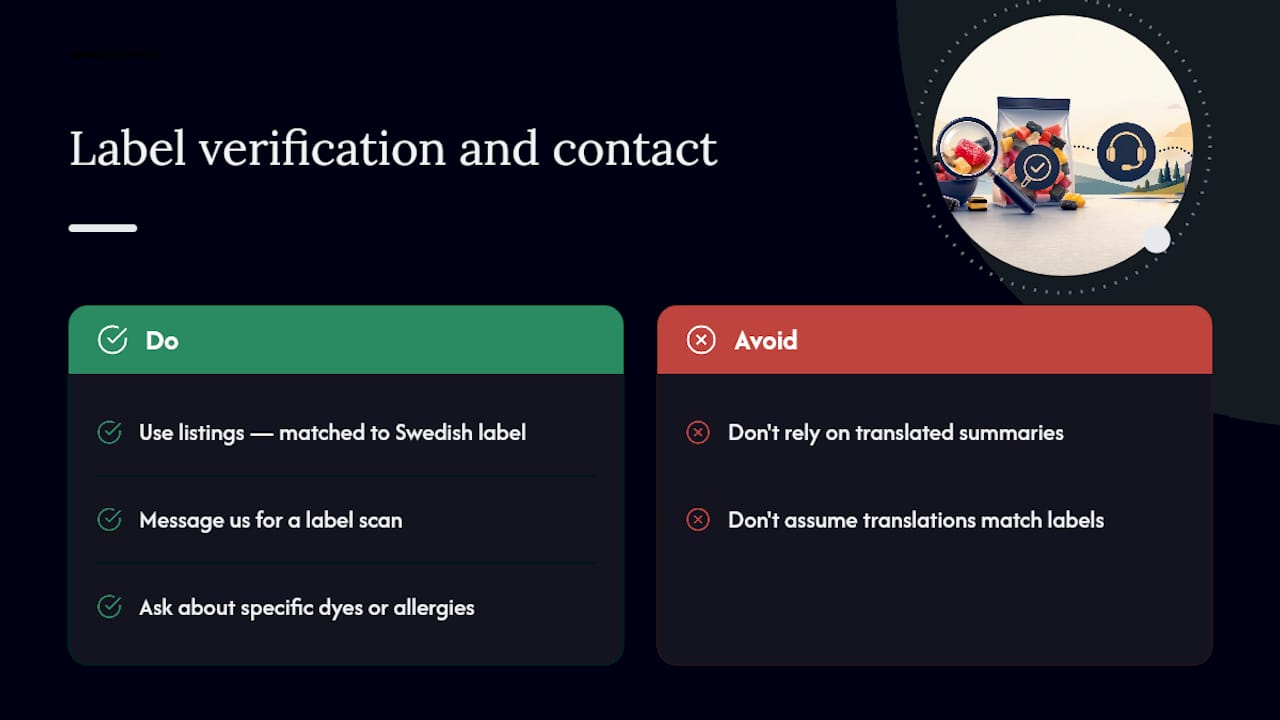
We check our ingredient listings against the actual Swedish label, not a translated summary, so what you read on our product pages matches what’s in the bag. Have a specific dye or allergy question? Message us and we’ll send the label scan directly.
Where to Find Verified Red 40 Free Swedish Candy
Reading E-numbers on every package gets old fast, which is why Sweetsbysvea built its product pages around full, verified ingredient listings instead of vague marketing copy. Every item ships from real Swedish inventory, sourced from the same brands you’d find on a shelf in Stockholm, not a reformulated export version aimed at a different market.
Start with the Candy Lovers Favorite mix if you want a curated selection without digging through individual labels yourself. Prefer something specific? The Swedish Fish and Ahlgrens Bilar pages both list full ingredients up front, so you can confirm the colorant before checkout instead of after your bag arrives. Every order ships within one to three days worldwide, and if a product page doesn’t show enough detail for your comfort, send us a message and we’ll get you a label scan directly.
Sources
- Summary report of the dietary reference intakes | National Academies
- What are E-numbers? | Lehmann Ingredients
- What Products Contain Red 3 Dye? | FoodManufacturing
This article is general information, not a substitute for advice from a qualified doctor. Consult a qualified healthcare professional about your own circumstances before acting on anything here.